

Trading platforms and software make a large part of a trader’s routine and, as such, play a significant part in their trading performance. The effect is more than practical; picking the right platform also has psychological benefits.
Have you ever felt frustrated while using a platform? It’s either too slow, the interface is unintuitive, or the tools are lacklustre? This is not an unusual sentiment, and many traders have experienced it.
Finding a platform that suits your needs not only gives you the tools you need for your day-to-day trading, it also reduces emotional strain and fatigue. Obviously, you trade better when you’re mentally well rested. However, beyond that, it may also help with trading psychology, preventing emotional trading, enabling better risk management, and increasing the length of your effective trading hours.
As such, putting in the time to research the best platform for yourself is a crucial step in any trader’s journey. Some may have more flexibility than others in this regard, but nobody wants to feel like opening their trading software is a chore.
In today’s article, we’ll outline some of the most common trading solutions and how they affect a trader’s experience.
Your Trading Platforms and Your Broker
If every broker offered every platform, finding the right one would be much easier. However, unfortunately, that’s not the case. As such, brokerage choice is another funnel when it comes to choosing a trading platform.
A broker’s service overall triumphs over the platform itself. Traders need to find the right balance between the right broker and the right platform. Sometimes a brokerage’s conditions won’t suit you, but the platform feels great. Other times, it’s the other way around.
The balance here is highly personal. Some traders will settle for sub-par conditions for a better platform, and others will want to chase the cutting edge when it comes to other key features. However, here are some practical notes:
- Don’t forget pricing – trading is about profits after all
- Ensure that your brokerage has at least the minimum necessary for your trading routine in terms of instruments and accounts
- Take your trading strategy into account – which tools do you really need?
- Stay safe, a lot of malicious brokers are there, and don’t accept weak security for the potential of better conditions
With that in mind, platform availability is a key thing to consider. Simply put, if a platform is widely available, it’s much easier to find a broker that suits you and offers that platform. As such, traders who change brokers often or want to have options often may opt to make more widely available platforms their primary trading tool.
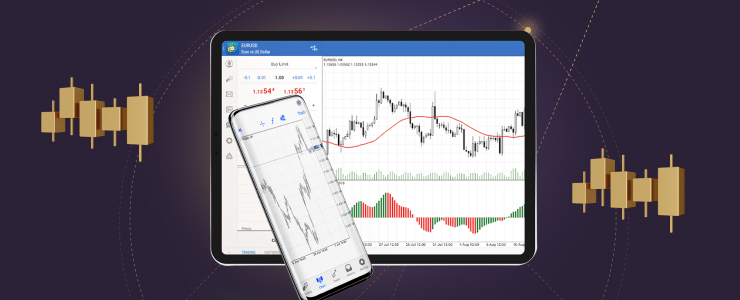
MetaTrader 4
Starting with the classic, MT4 is the most widespread trading platform available in the forex and CFD space. That may make you think that it’s just easy to implement or an overly simple generalist tool, but that’s far from the truth.
In fact, many competent traders start with MetaTrader 4 and simply never move away from it. That’s because, at a baseline, it’s quite a simple platform. It has all the tools traders need to enter the markets and build fundamentals, while also providing depth via its custom features, crafted with the MQL4 programming language.
MetaTrader 4 Standout Features
- 30 built-in indicators
- EAs for custom features and automated trading
- Backtesting support
- Multiple order types and execution models
- Most widely available platform
- Strong community devoted to developing custom tools
MetaTrader 4 Trading Platform Drawbacks
While MT4 is a potent tool, it’s not without its shortcomings. It is nearly 20 years old at this point, and the market moves fast.
- Somewhat dated interface
- Limitations in backtesting and more complex features
- Weak compared than other trading platforms out of the box
Who is it for?
MetaTrader 4 is a good option for traders who want a versatile, widely available platform available in nearly any brokerage. It’s easy to learn, making it good for beginners, and its customisation gives it near infinite potential.
On the other hand, traders who want a strong baseline platform without the need to add functions and features, or those who go heavy on backtesting and algo trading, may find better options.
MetaTrader 5
MetaTrader 5 is, as the name implies, the successor to MetaTrader 4. Essentially, it’s an upgrade in most regards. However, it comes with two major drawbacks, which aren’t necessarily related to the platform itself.
The first is the slightly higher difficulty of learning it. Some traders find the interface more confusing, and thus the platform harder to learn. The second is that MetaTrader 5, while still popular, is less widely available than MetaTrader 4 by a significant margin. This may limit brokerage choices.
MetaTrader 5 Standout Features
- All of MetaTrader 4’s baseline tools and features
- 38 built-in indicators and 44
- Stronger multi-threaded, multi-asset, tick-based backtesting
- More order types and execution models
- Built-in economic calendar and news page
- A more flexible programming language with MQL 5
- 21 timeframes for more precise control
MetaTrader 5 Trading Platform Drawbacks
While MT5 is stronger than MT4 in most regards, it’s still not exclusively better. Most of that comes down to MT4’s massive audience.
- Smaller community and fewer custom tools than MT4
- Less widely available
- Brokers sometimes require specific accounts for MT5, with conditions that may not suit all trading strategies
- Slightly more complicated to learn
- Similar dated feel to MT4
Who is it for?
MetaTrader 5 is a great option for traders who feel like they’ve exhausted their options in MT4. It’s slightly stronger out of the box, so it may also be a better option for traders who don’t like customising their platform. In essence, it’s a perfect tool for those who want something a bit stronger than MT4, but don’t want to limit their brokerage options too much.
On the other hand, they also share some of the same drawbacks. There are stronger baseline platforms than MT5, and the interface still looks old, as MT5 came out only 5 years after its predecessor, 15 years ago.
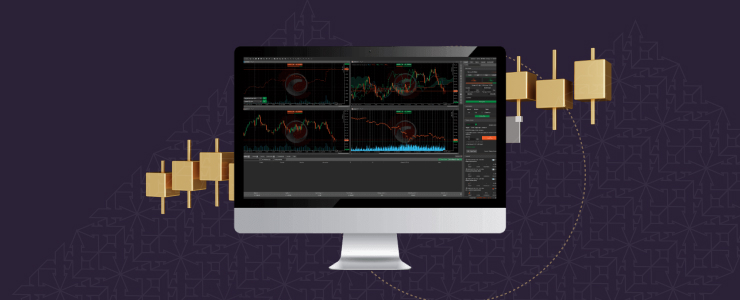
cTrader
cTrader is another well-known platform that is a favoured solution for many traders. It’s significantly more powerful in many regards at a baseline, looks much more modern, and uses the C# programming language, which is much more accessible to traders who want to make their own tools.
However, cTrader is much more rarely found in brokerages than the previous two trading platforms. It’s also based around a true ECN/STP model, making it somewhat inflexible. As such, traders may have trouble finding the right brokerage that offers it, and even if they do, they may not be able to execute their trading strategy properly.
cTrader Standout Features
- Advanced order types
- 26 timeframes
- 70+ indicators
- Risk tools for easier risk management
- Modern UI
- Cloud Sync feature
cTrader Trading Platform Drawbacks
While cTrader is likely more powerful than MT4 in all regards and MT5 in most at a baseline, it’s much rarer.
- Fewer custom tools, rendering the baseline advantage less beneficial
- Limits some trading strategies
- Worse at large-scale backtesting than MT5
- Limited brokerage choices
- Some may prefer MT5’s algo trading
Who is it for?
As a tool, cTrader is the best for those who want a strong baseline experience without the need for customisation. If you’re not an algo trader, the likelihood is that you’ll find cTrader at a baseline more gratifying than the MetaTraders.
However, keep in mind that when switching brokers, you’ll have to work much harder if you want cTrader as your platform, and perhaps accept some compromises when it comes to trading conditions. Additionally, putting in some work puts MetaTrader 4 and 5 at the same or a higher level than cTrader analytically.
Custom Trading Platforms
While these are the three most common direct forex trading platforms, there are many other options. The two traders will most often encounter are custom and copytrading platforms.
The great thing about custom platforms is that they are usually specialised for the service that the broker provides. As such, if you’re using a, for instance, low-spread broker for scalping and they have a custom platform, it may perform better at that task specifically than generic solutions like those above.
The issue, however, is obvious. If you ever stop using that broker, you lose access to the platform completely. As such, most traders don’t use these as their long-term primary platforms, since they are bound to use another service eventually.
We can’t really describe the features of custom platforms, as they are far too varied to be described in one swoop. However, if your broker does offer one, it may be a smart idea to check it out.

Copytrading
Copytrading is gaining traction, although it’s not trading in the traditional sense. As such, these aren’t really platforms.
However, they do have their role in trading. Experienced traders can share their strategies and potentially gain another earning avenue, and inexperienced ones can follow said strategies, albeit for a small premium.
While again, these can’t be your main platform since they aren’t actually trading platforms, they are a nice tool to include if you either still lack confidence or are very confident in your abilities.
Trading Supplements
Finally, we have supplementary tools like Trading Central and TradingView. TradingView in particular does support integration as a trading platform. These tools allow traders to go into much more depth manually.
Many brokers offer them as add-ons, and if you find your base platform lacks in analytical strength, it may be a good idea to supplement it with one of these tools. They come with economic calendars, hundreds to thousands of indicators, sentiment tools, and overall, everything most traders need.
Pick What Trading Platforms Suits You
At the end of the day, few platforms are objectively better than others. A new trader may enjoy MetaTrader 4 over more powerful platforms, and someone with more traditional inclinations may pick cTrader as their go-to, since it doesn’t require any added work.
To find your sweet spot, you’ll need to do some testing to see how the practical experience of each platform. It’s wise to try out different options, as guides can’t really describe how the platform will handle practically.
Finally, don’t be afraid to explore added tools to enhance your trading game, as these are often standalone services that can be applied to any platform you use. Pick the right toolset and you’ll be confidently trading in no time!
DISCLAIMER: This content is for general informational and educational purposes only and should not be considered investment advice or investment recommendation.