

Today’s market environment is defined by a fragile balance and heightened uncertainty, as investors attempt to interpret mixed signals from US monetary policy and escalating geopolitical tensions in the Middle East. The US dollar shows signs of stabilisation, yet its direction remains heavily dependent on safe-haven flows and further guidance from the Federal Reserve. At the same time, developments surrounding Iran continue to elevate risk across energy and equity markets. In this climate, investors are acting more cautiously, with major asset classes reacting more to headlines than to fundamentals—suggesting that short-term market direction will likely continue to be driven primarily by geopolitical developments.
USD stabilises
The USD tended to stabilise in today’s Asian and European sessions against its counterparts in the FX market. It should be noted that the release of the US ISM non-manufacturing PMI figure for March released yesterday may have disappointed traders a bit as it came in lower than expected. Also on monetary level, we note that Fed policymakers reiterated their concerns for inflationary pressures in the US economy, which tended to sound hawkish We still see safe haven flows as the key issue for USD’s direction today, especially given the end of Trump’s ultimatum to Iran.
Xcellence Research Team opinion
Should we see a deal being announced for a ceasefire in the US-Israeli war on Iran, we may see the USD retreating, while a possible escalation off the war could lift the USD. Also further hawkish comments by Fed policymakers could provide support for the USD and vice versa.
Trump’s deadline pushes oil prices higher
Trump’s deadline on Iran to reach a ceasefire deal, with an opening of the Straits of Hormuz. It should be noted that Trump in a post on Sunday threatened to hit Iranian energy and transportation targets, if Iran failed to agree to a ceasefire deal, leading to the opening of the Straits of Hormuz. It should be noted that the deadline ends at 20:00 Washington DC time, today. The Iranians showed no intention of complying, even at some point trolled the US President. Given that the stakes are high but also the risk factor for the international oil market is high, oil prices got another premium in today’s Asian and European sessions. It should be noted that such US-Israeli airstrikes, are expected to provoke countermeasures with energy targets in various Gulf countries and Israel being possible. On the other hand, do not be surprised to see the US President extending the deadline.
Xlence Research Team opinion
Should we see an intensification of US-Israeli airstrikes in Iran, as threatened by the US President, we may see oil prices rallying, while on the flip side a possible de-escalation, which currently seems to be remote yet still possible could weigh on oil prices.
WTI H4 Chart
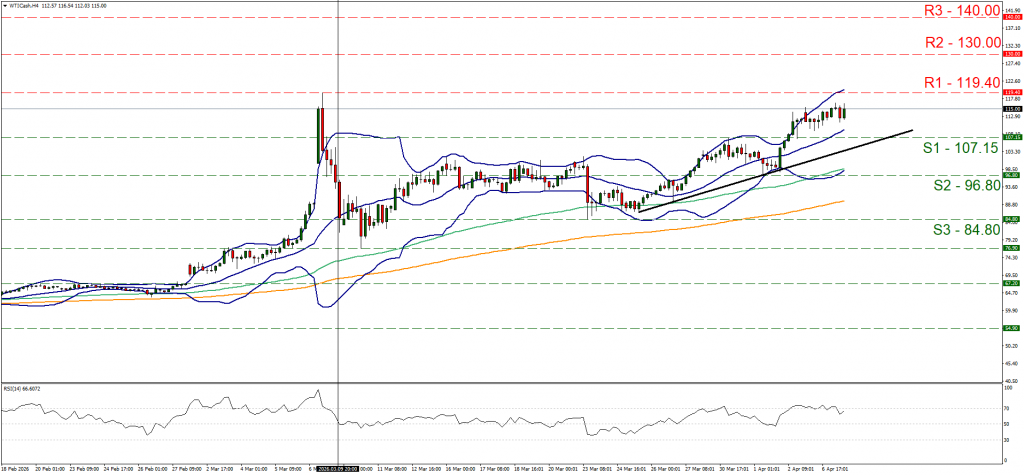
- Support: 107.15 (S1), 96.80 (S2), 84.80 (S3)
- Resistance: 119.40 (R1), 130.00 (R2), 140.00 (R3)
On a technical level we continue to maintain a bullish outlook for WTI’s price action. We note that the RSI indicator remains near the reading of 70, which implies that the market has a strong bullish sentiment for the commodity’s price, yet at the same time, a correction lower is also quite possible as the commodity’s price seems to be at overbought levels. Next possible target for WTI bulls being set at the 119.40 (R1) resistance line.
US equity holders remain cautious
US equities were on the rise yesterday as hopes for a possible deal between Iran and the US were increased, improving the market sentiment. Yet a correction lower in today’s Asian and European sessions, for major US stock market indexes, such as Nasdaq, S&P 500 and Dow Jones, was telling a different story. US equity markets seem to remain uneasy with the possible consequences of the war in Iran. On a sidenote, Google and Broadcom shook hands in a long term deal for the latter to produce AI chips for the former, which could provide support for the shares of both of the prementioned companies.
Xlence Research Team opinion
Should market worries for the war in Iran intensify, we may see US equities being on the retreat, while a possible easing of tensions, may allow the market’s risk oriented approach to re-emerge and thus US equities may rise again.
Gold remains stable, Bitcoin corrects lower
Gold’s price remained rather stable yesterday and during today’s Asian and European sessions. The stability of the precious metal’s price tends to highlight its current ineffectiveness as a safe-haven instrument. On the contrary we would not be surprised to see the negative correlation of gold’s price to the USD being active. On the other hand Bitcoin’s price rise yesterday in a signal of an improved risk appetite of the markets. Yet the correction lower in today’s Asian and European sessions seems to be cancelling any bullish tendencies of the crypto-king’s price action.
Xlence Research Team opinion
Should we see the USD being on the rise later today, we may see gold’s price losing ground, while on the contrary a retreat of the USD could provide support for gold’s price. An improvement of the market sentiment on the other hand, may provide support for Bitcoin’s price.
XAU/USD H4 Chart
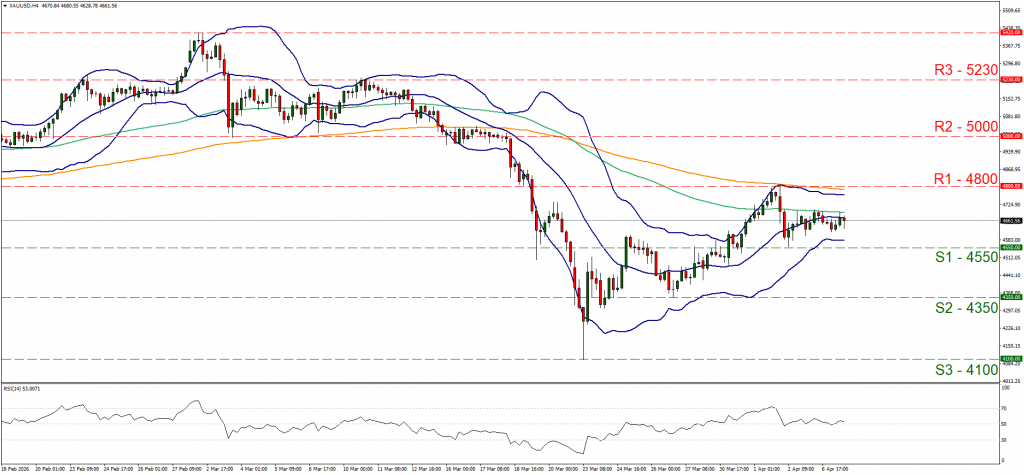
- Support: 4550 (S1), 4350 (S2), 4100 (S3)
- Resistance: 4800 (R1), 5000 (R2), 5230 (R3)
Gold’s price remained well between the boundaries set by the 4550 (S1) support line and the 4800 (R1) resistance level. We maintain our bias for the precious metal’s price sideways motion to continue, given also that the RSI indicator continues to run along the reading of 50, implying a rather indecisive market. For a bullish outlook to emerge, we would require gold’s price to breach the R1 and start aiming for the 5000 (R2) resistance barrier. Should the bears take over, we may see gold’s price sinking by breaking the 4550 (S1) support line and start aiming for the 4350 (S2) support base.
Disclaimer: This information is not considered investment advice or an investment recommendation, but instead a marketing communication.