



Earlier today, the Bank of Japan decided to go ahead and increase its short-term interest rate by 25 basis points to the 0.75%, reaching its highest level since September of 1995 and alter further its longstanding, ultra-loose policy stance.
This has been the second time this year that the central bank for the far east decided to move up a notch its key policy rate as price pressures in Japan have emerged and have stayed above the BoJ’s 2% target since April of 2022. For context, headline CPI in Japan did not experience the magnitude of flare ups Western nations saw over the same period of time, but its has rather fluctuated between 2%-4% bounds and remains stubbornly stagnant around and about the 3% level currently.
Besides the persistence of price pressures however, BoJ policymakers incorporated forecasts for PM Sanae Takaichi’s dovish fiscal policy plans into the mix, expecting that the expansionist tactics of the government will inadvertently fuel the rise of inflation, hence found another reason to go ahead with the hike. Evidently yesterday, the prime minister noted that Japan must pursue proactive fiscal measures to support growth and increase tax revenues.
Governor Ueda has refrained from clearly committing to the “more hikes are coming” narrative, expertly manoeuvring interviewers’ speculative questions and instead emphasized that the bank remains flexible at responding and deploying its policy agenda, depending on the evolvement of future economic and financial developments. Money markets nevertheless speculate that the BoJ will push rates at least as high as 1% at the start of the second half of 2026.
The Japanese Yen paradoxically came under pressure against nearly all its counterparts post the hawkish decision (was expected to strengthen the currency given the hike), but traders most likely fixated upon the vague, unguided projections from the BoJ in regards to future policy actions. Japanese equities on the other hand, found respite and rose higher on the back of a weaker Yen, but also from the support of the cooler-than-expected US CPI print for the month of November, improving risk sentiment for global equities.
The Japanese Yen slipped by over 1% against the greenback and trades dangerously close to 1986 lows, giving rise to worries that the Japanese finance ministry may soon intervene, to safeguard the currency from experiencing severe devaluation from predatory speculators.
Technical Analysis
USDJPY Chart – The Yen weakens by over 1% against the greenback, extending the “carry trade” play
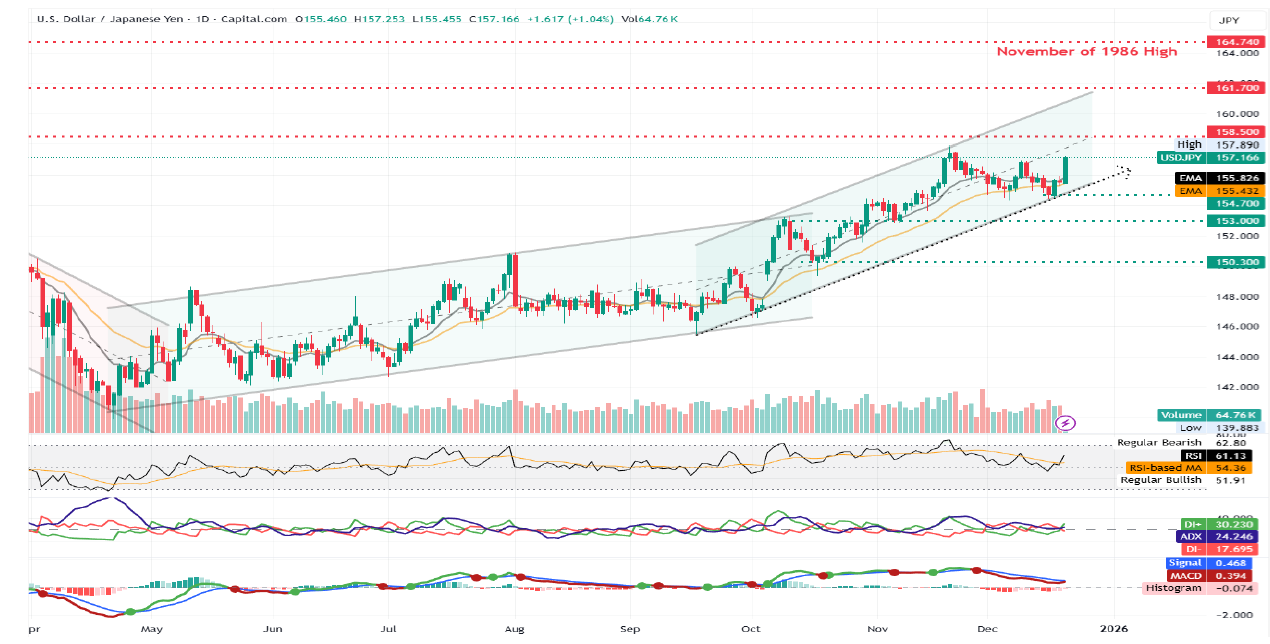
Resistance: 158.50 (R1), 161.70 (R2), 164.74 (R3)
Support: 154.70 (S1), 153.00 (S2), 150.30 (S3)