


- Gold regains positive traction on Monday as Fed rate cut bets continue to undermine the USD.
- Geopolitical risks further benefit the safe-haven commodity, though the upside seems capped.
- Traders now seem reluctant ahead of the highly anticipated FOMC rate decision on Wednesday.
Gold (XAU/USD) sticks to its modest intraday gains through the early European session on Monday, though it lacks bullish conviction and remains confined in a one-week-old trading range. The growing acceptance that the US Federal Reserve (Fed) will lower borrowing costs again this week keeps the US Dollar (USD) depressed near a one-month low and acts as a tailwind for the non-yielding yellow metal. Apart from this, the cautious market mood and geopolitical uncertainties turn out to be other factors offering some support to the commodity.
Despite the supportive fundamental backdrop, the XAU/USD bulls seem reluctant and opt to wait for more cues about the Fed’s rate-cut path before placing fresh bets. Hence, the market focus will remain glued to the outcome of a two-day FOMC meeting on Wednesday. This, along with the updated economic forecast and Fed Chair Jerome Powell’s comments at the post-meeting press conference, will influence the USD and provide a fresh impetus to the Gold price. In the meantime, the commodity is more likely to extend the range-bound price action.
Daily Digest Market Movers: Gold bulls not ready to give up; Fed decision awaited
- A delayed report published by the US Commerce Department on Friday showed that the Personal Consumption Expenditures (PCE) Price Index rose 2.8% on a yearly basis in September, matching consensus estimates.
- The core PCE Price Index, the Federal Reserve’s preferred inflation gauge, rose 2.8% in September compared to 2.9% in August. Moreover, signs of a cooling US labor market back the case for more easing by the Fed.
- According to the CME Group’s FedWatch Tool, traders are pricing in a nearly 90% chance that the Fed will lower borrowing costs again this week and a greater chance of another rate reduction by April next year.
- The dovish outlook fails to assist the US Dollar to register any meaningful recovery from its lowest level since late October and revives demand for the non-yielding yellow metal during the Asian session on Monday.
- Russia carried out a massive missile-drone attack on power stations and other energy infrastructure in Ukraine. Moreover, slow progress in the Russia-Ukraine peace talks benefits the safe-haven XAU/USD pair.
- Despite the supporting factors, bullish traders seem reluctant to place aggressive bets around the commodity and opt to wait for the outcome of the highly anticipated two-day FOMC policy meeting on Wednesday.
- Given that a 25 basis point rate cut is nearly fully priced in, investors will look for more cues about the Fed’s future policy path. This will play a key role in providing a fresh impetus to the USD and the commodity.
Gold remains confined in a one-week-old trading range; bullish bias intact
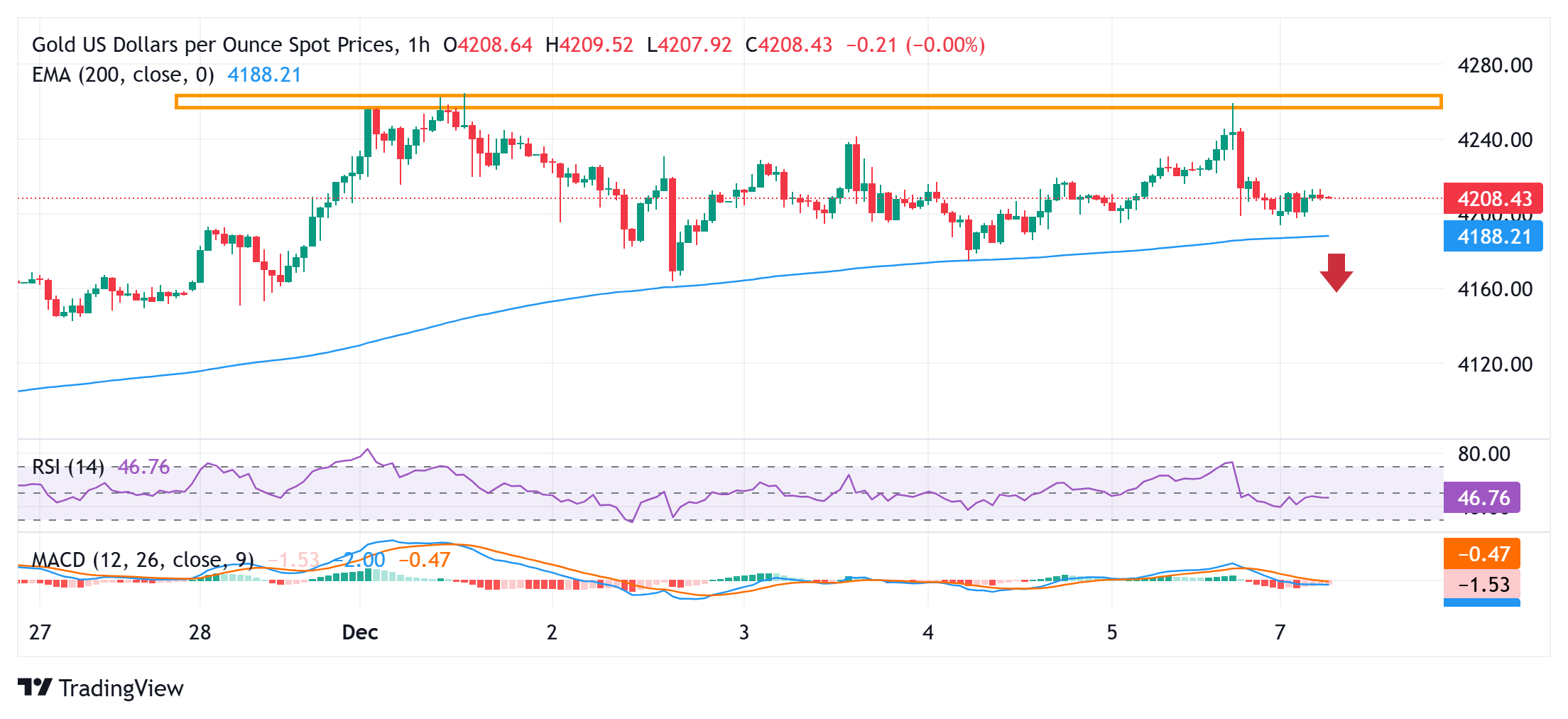
The 200-hour Exponential Moving Average (EMA) has been offering some support to the XAU/USD pair since the beginning of this month. The said support is currently pegged near the $4,190 area and should act as a key pivotal point for short-term traders. A convincing break below might prompt some technical selling and make the Gold price vulnerable to accelerate the fall towards the $4,164-4,163 region, or the monthly swing low, en route to sub-$4,100 levels. The latter represents a short-term ascending trend-line extending from late October, which, if broken decisively, will be seen as a fresh trigger for bearish traders and pave the way for deeper losses.
On the flip side, the $4,250-4,260 region might continue to act as an immediate strong barrier. A sustained strength beyond could lift the Gold price to the next relevant hurdle near the $4,277-4,278 area before the bullion aims to reclaim the $4,300 mark. Some follow-through buying will be seen as a key trigger for the XAU/USD bulls and pave the way for the resumption of the uptrend witnessed since the late November swing low.
US Dollar Price This Month
The table below shows the percentage change of US Dollar (USD) against listed major currencies this month. US Dollar was the strongest against the Swiss Franc.
| USD | EUR | GBP | JPY | CAD | AUD | NZD | CHF | |
|---|---|---|---|---|---|---|---|---|
| USD | -0.45% | -0.64% | -0.47% | -1.13% | -1.34% | -0.83% | 0.08% | |
| EUR | 0.45% | -0.21% | 0.00% | -0.66% | -0.88% | -0.38% | 0.53% | |
| GBP | 0.64% | 0.21% | 0.43% | -0.50% | -0.71% | -0.19% | 0.72% | |
| JPY | 0.47% | 0.00% | -0.43% | -0.68% | -0.90% | -0.38% | 0.53% | |
| CAD | 1.13% | 0.66% | 0.50% | 0.68% | -0.27% | 0.31% | 1.22% | |
| AUD | 1.34% | 0.88% | 0.71% | 0.90% | 0.27% | 0.52% | 1.44% | |
| NZD | 0.83% | 0.38% | 0.19% | 0.38% | -0.31% | -0.52% | 0.92% | |
| CHF | -0.08% | -0.53% | -0.72% | -0.53% | -1.22% | -1.44% | -0.92% |
The heat map shows percentage changes of major currencies against each other. The base currency is picked from the left column, while the quote currency is picked from the top row. For example, if you pick the US Dollar from the left column and move along the horizontal line to the Japanese Yen, the percentage change displayed in the box will represent USD (base)/JPY (quote).