

Today’s financial world is fast moving, and numerous traders are choosing forex trading as they step away from traditional investments like stocks or bonds. The foreign exchange market, or forex market, is a market that keeps gaining attention. In the past, only large banks and multinational companies would trade currencies but with the advancement of technology, individual traders from all around the world can trade too.
Forex trading offers valuable features including flexible trading hours, lower costs and more, which draws more people away from usual trading options.
In this article, we explain what forex trading is, the reasons it appeals to most traders, how it’s different from familiar assets as well as the risks each trader should know before getting started.
Understanding why traders are choosing forex trading
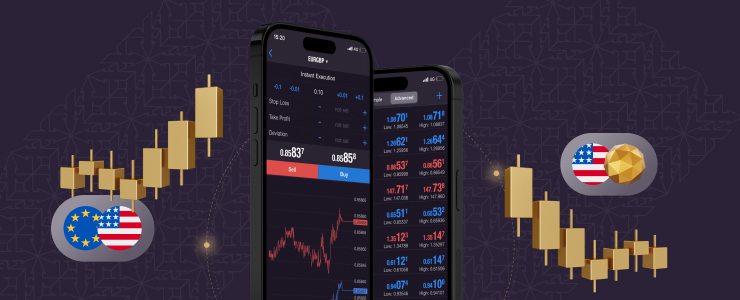
Trading forex refers to the buying and selling of currencies in a worldwide market. Rather than owning a company of a physical asset, traders try to generate revenue from changes in the value of one currency compared to another. For instance, if a trader expects the EUR to strengthen, they might buy euros while selling U.S dollars.
Being the largest financial market globally, the foreign exchange market is open 24/5 across every time zone. Trading is conducted online so transactions are electronic. Therefore, anyone with a computer, smartphone or internet connection could participate. The market’s accessibility is one of the main reasons why forex has grown so fast among retail traders.

What are the forex market offer?
High liquidity and fast execution
One of the most appealing factors in this market is the size of liquidity. There are trillions of dollars traded in the market daily, allowing buyers and sellers to almost always find someone to trade with right away. As a result, there are rarely delays or big price gaps when trades are opened and closed. This is not the case in the stock market for example.
Low transaction costs
Additionally, there are generally low transaction costs. Traders usually only pay the forex broker the spread which is the small difference between the buying and selling price of a currency pair, instead of a large commission. This is very useful especially for those who trade frequently.
24-hour market access
Also, the market is open round-the-clock, which is another valuable feature of forex. Traders can trade almost anytime during the week since forex trading moves across time zones, from Sydney to Tokyo to London and New York.
For instance, someone in Europe can easily respond to economic announcements from Asia early in the morning, while another trader in the U.S can trade on events happening in Europe at night. By contrast, in traditional exchanges there are fixed opening and closing times. This is limiting when it comes to placing trades.
Leverage and market exposure
Leverage also makes the foreign exchange market stand out. With it, brokers enable traders to control much bigger positions compared to the size of their account. In this way, even a small deposit can provide significant exposure to the market. Keep in mind that leverage increases the chance for revenue, but it also increases the risk for losses, so you will need to have solid management in place.
Accessibility for new and small-account traders: Why traders are choosing forex trading
Last but not least, the FX market is especially suitable for new traders and those who have smaller accounts. Also, the majority of traders offer a free demo account, low minimum deposits and straightforward trading platforms. All these allow traders to practise, test strategies and gain experience before entering with real money. This is harder to achieve with large stock portfolios.

Forex vs traditional investments: why traders are choosing forex trading
Flexibility is what clearly sets forex and more familiar trading choices apart. Stock exchanges or bond markets are typically open during certain hours and execution isn’t usually fast.
On the contrary, forex allows traders to respond instantly to events happening around the world. An unexpected central bank decision or political announcement can move currency pairs’ prices in seconds, and therefore, traders can take action in real time.
The costs to enter are also different. You will usually need significant capital to buy a diverse basket of stocks for instance. Forex makes it easier for someone to start with a modest amount of money because of the market’s low minimum deposits and the ability to trade micro lots.
Although traditional markets may offer dividends or a steadier growth in the long term, forex provides opportunities in both rising and falling markets. This makes it attractive to those traders to are more into active trading.
Why traders are choosing forex trading over traditional investments ?
Nowadays, there are several things that make forex even more accessible. Online trading platforms have become faster, easier to use and have real-time charts, mobile apps or built-in risk management tools that help traders take action fast. There is also increased currency volatility because of global economic uncertainty.
Central bank policy, changes in interest rates and geopolitical tensions often lead to drastic movements in exchange rates, which provides traders with more trading opportunities.
Strategies like the “carry trade” have been encouraged by low interest rates in some places around the world. This strategy refers to when traders borrow money in a currency with low interest and use it to buy one that pays higher interest. Other than that, many traders want to diversify their portfolios beyond stocks and bonds. Adding the exposure of currency into a trading portfolio can help spread risk and limit dependance on just one market.
What are the risks and challenges of trading forex?
Although there are many valuable features in the forex market, there are always some risks involved. As already mentioned, leverage may increase profits but losses as well.
A tiny market move in the opposite direction may remove a trader’s total amount of funds without risk management.
Currencies are greatly impacted by factors such as economic reports, interest-rate decisions, political events and more. It generally takes time to study and understand these factors’ impact and how the market works.
Forex can also be demanding, emotionally. Unexpected price changes may lead to impulsive decisions based on fear or greed. A reliable forex broker and useful tools like stop-loss orders are key steps to enter the market.
5 tips to start trading forex
- Learn the fundamentals of forex forex terminology and how forex works
- Test your strategies on a demo account before using real funds
- Use tools such as stop-loss orders to limit possible losses
- Have a clear trading plan and well-defined risk management. Risk only 1-2% of your account
- Be patient, disciplined and keep learning
Final thoughts
It is not accidental that there is a growing interest in forex trading. Having high liquidity, low costs, flexible trading hours and multiple opportunities to generate revenue under different market conditions are some of the factors that make forex different than traditional investments. Nevertheless, all these still require planning ahead, having a strong strategy and controlling risk.
For those traders who like a dynamic, fast-paced, and international setting, forex can be an exciting addition to a trading portfolio. For those seeking slower and consistent growth, more conventional investments may still be the best option.
DISCLAIMER: This content is for general informational and educational purposes only and should not be considered investment advice or an investment recommendation.